
Why the child's dialect matters
Arabic-speaking children grow up hearing a spoken dialect at home, not the formal Arabic found in most learning materials. A child who hears "shu hada?" at home may not easily link the formal "ma hatha?" to the same meaning, especially early in language learning. And the same object can have a different everyday name from one country to the next.
When a card is shown in the child's dialect, the child learns the word as it will be heard and used at home, which makes it easier to carry a skill from the session into daily life. That is why the Enable 360 concepts library was built on dialects from the start.
11 Arabic dialects
| Region | Dialects |
|---|---|
| Levant | Jordanian, Palestinian, Syrian, Lebanese |
| Iraq | Iraqi |
| Gulf | Saudi, Kuwaiti, Emirati, Qatari, Bahraini, Omani |
- Every word, sentence and question is written in its dialect, with full vowel marks so it is read correctly.
- Voices are natural, close to how parents talk to their children.
- Each dialect has native reviewers, and only what they approve appears in the library.
- Photos follow the dialect's region where things look different, such as clothes and food.
- The child's dialect is set in their file, so the library opens in it in every session.
A large, organized library
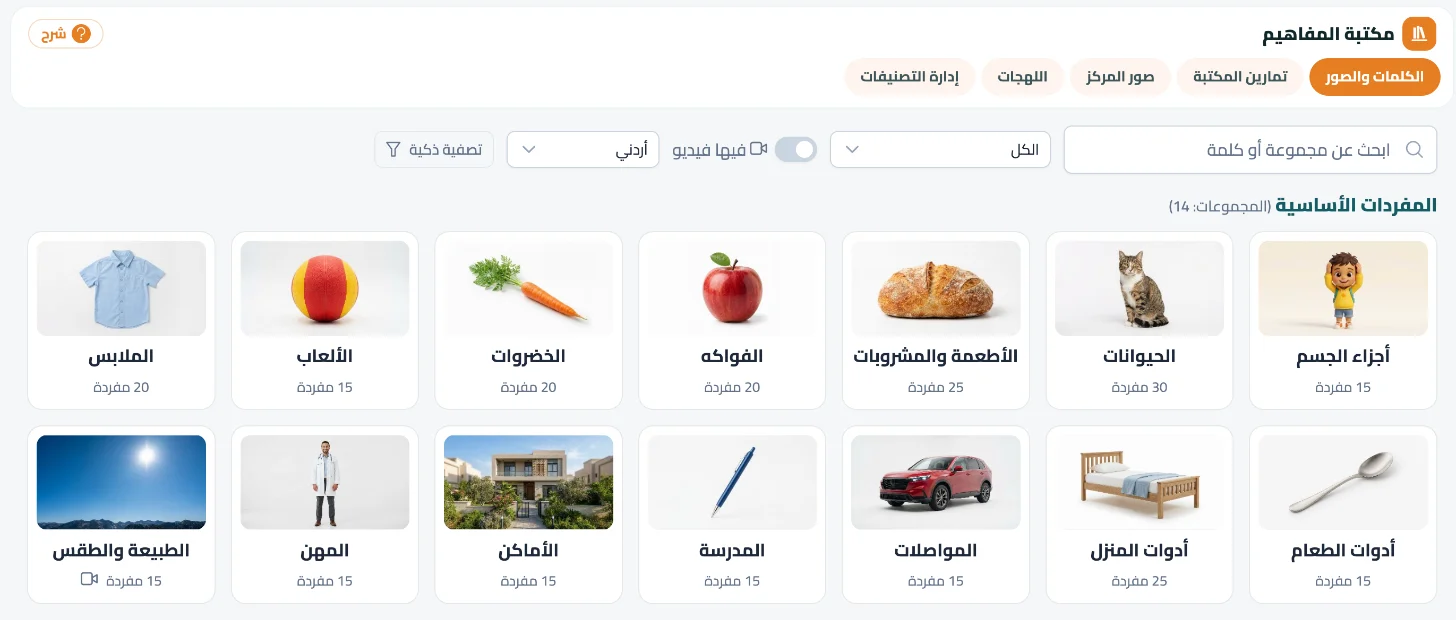
The library holds words, sentences and questions with real photos, grouped the way speech and language therapists work:
- Core vocabulary: animals, fruit, vegetables, food, clothes, body parts, toys, household items, transport, school, jobs, places and nature.
- Expanded vocabulary: plants, birds, sea animals, sports, landmarks, tools, personal hygiene and growth stages.
- Sounds: letter cards and their sounds, plus environmental sounds such as a bell, rain or animals.
Each concept carries overlapping tags and is linked to assessment domains and speech and language skill levels, so therapists find what fits a child's goal with smart filters instead of long browsing.
Full-screen interactive exercises
Next to the cards, the exercise player offers formats for different goals:
- Pick the picture: the child hears a word and picks its picture.
- Listen and choose: the child hears a question in their dialect and answers.
- Memory: flip cards to find pairs.
- Sort into baskets: put each picture in its group.
- Shadow match: match a picture to its silhouette.
- Spot the difference between two pictures.
- Point to places in a picture.
Questions, praise and applause are spoken in the selected dialect, and a correct answer moves on automatically, so the therapist does not need to touch the device between questions.
The child's album: photos from their life
Some concepts are learned faster when the picture comes from the child's own life: their mother, their cup, their favorite toy, their room. The child's album lets the center and parents upload real photos that are used in the session alongside the library. The album is shared between the center and parents through the portal.
Inside the session, without leaving it
The library opens over the session screen without closing it, so time, goals and recording stay in place. The therapist moves between an exercise and recording a response in seconds.
Want to see this on cases like yours?
We demo the system on cases close to your center's work, starting with your needs.
Book a live demoFAQ
Is the library available in formal Arabic too?
Dialects are the core, and the therapist chooses the right dialect for each child. Centers decide which dialects fit their children.
Can the center add its own photos?
Yes. Center photos are added to the library, and the child's photos go to their album.
Does the therapist have to touch the device during exercises?
A correct answer moves to the next question automatically, so the therapist steps in only when the child needs help.
How is each word checked in each dialect?
Each dialect has native reviewers, and only approved content is shown.
Can concepts be linked to plan goals?
Yes. Concepts are linked to assessment domains and appear as suggestions when choosing the items each goal is taught with.
Sources
Last updated: